

Top Message
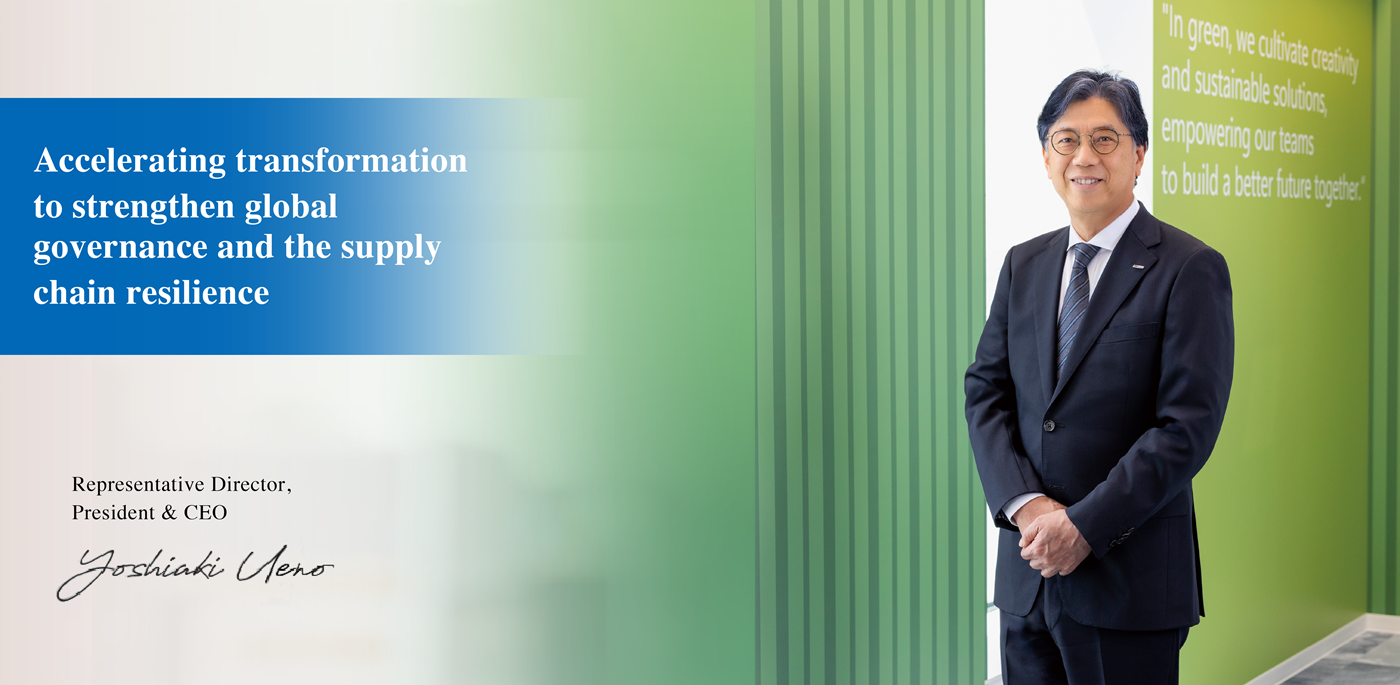
Enhancing supply chain resilience for sustainable growth
The Group is promoting initiatives across three phases under our Medium-term Management Plan (CCC) as we work to achieve our Long-term Strategic Vision for 2030: "Create and Innovate, Care for the Earth, Color for Life." FY2025 was the second year of the second phase of our Medium-term Management Plan (CCC-II), which is positioned as a phase for business expansion and enhanced profitability. It also marked the midpoint on the path toward our Long-term Strategic Vision. During this period, we achieved three consecutive years of increases in both sales and profits, with net sales and operating income growing by approximately 8% and 15% per year, respectively, since FY2021. I believe these achievements are the result of the steady accumulation of initiatives in each region, as well as our supply structure, product appeal, and investment direction coming together.
Alongside this growth, the situation in Iran that emerged in 2026 led to a sharp rise in prices for raw materials used in printing inks and processed products, many of which are derived from naphtha, significantly altering the operating environment. For FY2026, the final year of the CCC-II phase, we expect net sales to reach the planned level, while operating income is expected to fall slightly short of the plan. However, we are continuing our efforts to increase both sales and profits.
The Group primarily handles packaging products for beverages, food, daily necessities, and other items, and operates in more than 60 countries, with sites in over 20 countries and regions. As an essential business closely connected to people’s daily lives, we recognize that fulfilling our supply responsibilities in the global market is an extremely important duty. From this perspective as well, we see the current situation in Iran as an emergency risk and have established a response headquarters to ensure the stable procurement of petrochemical-based raw materials and the stable supply of products, as well as to respond to rising material prices. Through this, we are gathering information and making swift decisions.
To date, we have enhanced our resilience by transforming our systems to enable rapid responses to sudden risks and by reviewing our supply chain structure. Specifically, we have strengthened our BCP (business continuity plan) response in light of geopolitical risks and enhanced partnerships through measures such as expanding and increasing the functionality of our product lineup in response to environmental regulations, etc. In doing so, we are pursuing vertical integration that extends to materials. Our acquisition of U.S.-based Coatings & Adhesives Corporation (C&A) in November 2024 was part of these efforts, and we intend to continue actively pursuing M&A globally.
In addition, as we pursue this vertical integration, we will build a structure that enables us to manage the entire supply chain in an integrated manner and contribute to the calculation of customers' Scope 3 data. We will further strengthen trusted procurement relationships with our suppliers by continuing to deepen their understanding of the Group's human rights policies and initiatives, conducting surveys using Global Compact Network Japan's CSR/Sustainable Procurement Selfassessment Tool Set with our own original questions added, and engaging in dialogue.
To further promote these initiatives, now is the time to shift our perspective toward global "total optimization."
Advancing structural reforms to achieve "total optimization" and drive further growth through strategic products
Until now, our basic policy has been "individual optimization" rooted in each region, and we have worked together with our sales and technical teams to carefully address our customers' issues. This approach is one of our strengths. At the same time, our customers, as well as brand owners further downstream, now expect us to provide the same level of service and quality consistently around the world. I believe we must respond steadily to these changes. To meet these expectations, it is essential to advance our supply chain management from a global perspective while leveraging regional strengths. To do so, we are advancing structural reforms to strengthen our supply chain through "total optimization," building on the foundation of "individual optimization."
As one of the specific initiatives, although the Group currently manages segments by region, we intend to newly manage segments by product field, such as packaging, metal cans, digital, and coatings. By gaining a firm grasp of global trends and taking an interregional approach, we aim to formulate and execute specific strategies in each region.
The Group has also been undertaking initiatives around the keyword "environmental friendliness," and we will further strengthen our supply chain from this perspective as well. Amid the growing global movement toward the 3Rs (reduce, reuse, and recycle), including the Europe's PPWR (Packaging and Packaging Waste Regulation), which came into effect in February 2025 with the goal of reducing packaging waste and promoting a circular economy, we need a structure that allows us to accurately understand these trends and respond swiftly as a Group.
We have also been focused on developing environmentally friendly products. This includes our botanical ink series, which actively makes use of plantderived materials; washable inks, which improve film recyclability by allowing printed ink to peel off when agitated after being immersed in a special solution; and coatings that contribute to mono-material packaging by adding functionality to natural resource-derived materials.
We are also focusing on chemical recycling initiatives in collaboration with external companies. We have taken a stake in R Plus Japan, Ltd., a joint venture that develops technologies for recycling used plastics as resources, and are moving forward with initiatives in the used plastics recycling business. By chemically decomposing used plastics through catalytic pyrolysis technology to convert them into basic chemicals and then recycling them, we aim to achieve efficient recycling with low environmental impact by 2030. I believe that further refining these environmentally-friendly technologies and expanding our product range will enable us to meet a wide range of customer needs and drive business expansion.
We are also working to develop new businesses to achieve our Long-term Strategic Vision. To create new materials leveraging the resin synthesis, dispersion and processing, and printing and coating evaluation technologies cultivated through our ink business, we are establishing development mechanisms, collaborating with a variety of companies and organizations, pursuing open innovation, and investing in startups. To date, we have promoted the four areas, business development domains, electronics & energy, bio-based and nonfossil materials, and healthcare as focus areas for new businesses, and based on market and industry trends that are changing due to recent advances in AI, while continuing these initiatives, we will focus investment particularly in electronics chemicals and biochemicals as the pillars of our growth strategy, accelerating the development of high-performance materials used in semiconductor processes.
Promoting globalization by transitioning to a holding company structure in 2027
In management, strengthening governance and accelerating decision-making are important issues for any company. The Group has set strengthening global management cooperation as one of our innovation projects, and has decided to transition to a company with an Audit and Supervisory Committee in March 2026 and to a holding company structure in January 2027. We hope to further evolve our management structure, accelerate decision-making, and assess the validity of decision-making processes from multiple perspectives.
The holding company will be responsible for functions such as formulating cross-organizational strategies, as well as R&D, financial management, human capital management, and production engineering, including quality control. At the same time, on the execution side, we will delegate greater authority to those responsible for implementation, thereby increasing speed on-site. We will also require the execution side to ensure higher standards for process validity and review quality and will engage in repeated professional discussions from the planning stage onward. Through these initiatives, we will achieve a management structure that ensures both speed and control.
As part of governance control, we are working to standardize ERP systems globally and strengthen our structure for aggregating data from sites around the world. By expanding the use of AI, we also aim to enhance and accelerate the planning and execution of marketing strategies, cash management, and technology development.
These initiatives are part of the structural reforms aimed at achieving our Long-term Strategic Vision and represent one milestone along that path. Under the new structure, the SAKATA INX Group will work together globally to enhance the value we provide to customers from three perspectives: economic viability, response to social issues, and response to environmental issues.
Furthermore, in transitioning to a holding company structure, we will create an organization capable of crossmanagement that enables us to conduct business from perspectives that go beyond regional boundaries. For example, engaging in dialogue with customers in the U.S. from Japan while carrying out manufacturing in Europe. To do so, I want our employees to have an even stronger awareness of what it means to be part of a global company. In CCC-II, we define our ideal human resources as "people who have a global perspective, make changes on their own, and enjoy trying new things with those around them," and are promoting an HR strategy built on four pillars: welcoming diversity, an environment that encourages the pursuit of challenges, enhancing education and HR development programs, well-being.
As a global company, we will continue to diversify our human resources. We will strengthen our efforts to acquire and appoint talented human resources globally, including by appointing non-Japanese employees to management positions, appointing human resources trained in various regions around the world to positions in Japan, and hiring overseas university students in Japan.
Since becoming president, I have held townhall meetings and GENBA Walks to engage in dialogue with frontline employees and to listen to each individual's voice. As we advance structural reforms, I believe it is more important than ever to further deepen communication with employees. I will continue to engage in dialogue to build an organization in which each employee proactively participates in transformation.
Continuing transformation to improve ROIC and increase corporate value
We are promoting management that is conscious of the cost of capital and positioning ROE as one of our most important management indicators. We have therefore adopted ROE as the calculation indicator for the performance-linked portion of officer compensation. We have set a target of ROE of 10% or higher for the final year of CCC-II, and in FY2025, ROE improved by 1.5 points from the previous fiscal year to 10.0%.
To improve capital efficiency, we continuously assess whether the returns on invested capital exceed the cost of capital. We are working to optimize capital allocation across growth investments, shareholder returns, and other uses, while striving to reduce the cost of capital. Since the CCC-II phase, we have developed ROIC trees for each business category to improve ROIC and visualize the link between ROIC and business operations. In our business plans, we have repeatedly discussed strategies to boost the ROIC spread and initiatives for processes like sales, production, purchasing, and logistics, which we have implemented. I believe these efforts are driving improvements in ROIC.
Since 1998, we have also been implementing TPM (Total Productive Maintenance, or getting employees proactively involved in production management) activities, pursuing the reduction of all forms of loss in our production systems and lowering costs. Going forward, we will expand these activities beyond production activities to purchasing, logistics, and sales processes, linking them to improvements in ROIC.
Looking at our valuation in the stock market, as of April 2026, our P/B ratio sits at 0.9 to 1.0 times, while our P/E ratio has remained at 9 to 10 times. Our goal is to raise these figures to a P/B ratio of 1.0 times or higher and a P/E ratio of 15 times or higher as soon as possible. Through dialogue with a broader range of investors, we will communicate a clear story: the Group's vision and future direction, how we create social and economic value by addressing social and environmental issues through our business activities, and how this leads to earnings growth.
Our direction for 2030 and the spirit of our corporate philosophy, "Mind within the Mind," which expresses the kind of company SAKATA INX is, where we are headed, and how our corporate activities should be conducted, remain unchanged. However, the way we interpret this philosophy is constantly evolving. We need to pursue an optimal approach as the use of AI significantly changes the volume and speed of information input.
I want the Group employees to become people who can pursue transformation on their own. We are seeing a steady increase in employees proactively raising their hands for our open career recruitment system and internship system, and I can feel a growing willingness among individual employees to take on challenges. Going forward, I expect even more employees to think for themselves and take on challenges with strong passion.
I will continue to stand at the forefront and drive transformation. By identifying changes in the global market and listening to voices from the frontlines, we will advance further transformation to achieve our Long-termStrategic Vision and improve corporate value. I ask for your continued and unwavering support of the SAKATA INX Group.