

Message from the Director in Charge of Finance
Designing the direction of the entire Group while overseeing finance and corporate planning
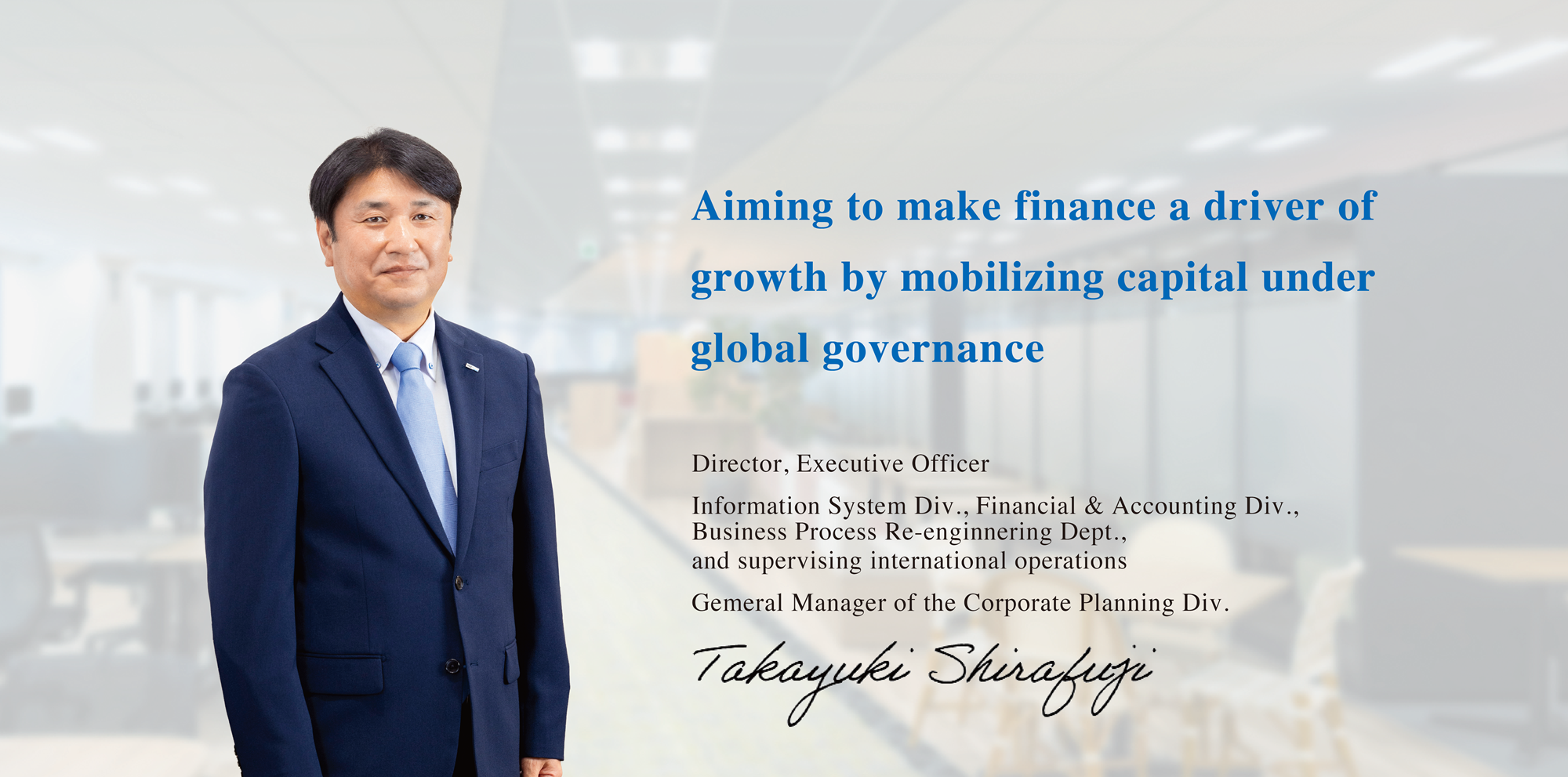
Since joining the Company in 1994, I have been consistently involved in finance and accounting. In Japan, I was responsible for operations related to overseas sales, overseas transactions, and trade, and during my assignment in the U.S., I was also involved in financing for the local subsidiary. I have been in charge of the Corporate Planning Div. since 2022, and since 2025, I have overseen the Corporate Planning Div. and the International Operations Dept. as General Manager of the Group Corporate Planning Div. I have also been in charge of the Finance & Accounting Div. and the Information Systems Div. since 2026.
From this position, I would like to explain our focus on finance and global governance, as well as our current initiatives.
As we operate in over 20 countries around the world, it is important to accurately assess the performance and financial position of local subsidiaries and their growth potential, while also taking market trends into account. We provide printing inks used in packaging for food, beverages, daily necessities, and other products, and operate with a strong awareness of the importance of a stable supply. For this reason, it is essential that we constantly understand our supply capacity, make planned investments, and ensure the stability and continuity of the entire supply chain. The role of finance is to support the business foundation and appropriately secure the necessary funds.
To grow in line with market growth, we must invest funds in businesses and regions where growth is expected, while balancing our supply responsibilities with growth. That is why it is important to have a mechanism to consolidate the funds generated by the Group as a whole and reallocate them optimally. I recognize this as one of the most important themes that will determine our growth.
Steadily conducting business operations with an awareness of capital cost management and ROIC to achieve an ROE of 10% or higher
We have set a target of achieving an ROE of 10% or higher as we work to sustainably enhance corporate value. In FY2025, we achieved increases in both sales and profits, recording operating income of 15.2 billion yen and net sales of 257.6 billion yen. By strengthening our business foundation through improved profitability, we achieved an ROE of 10.0%.
To maintain an ROE of 10% or higher going forward, it is essential to link the profits we generate to future growth. Because increases in profit are accompanied by an accumulation of equity capital, we need to operate while being aware of capital efficiency as we pursue profit growth.
For this reason, we will continue to practice management with an awareness of the cost of capital.
Based on this approach, we are advancing shareholder returns through dividends and share buybacks, using a cost of equity of 8 to 9% and a total return ratio of 50% as benchmarks. Remaining funds will be allocated to growth investments as we work to improve equity efficiency and sustainably enhance corporate value.
In FY2025, operating cash flow was 17 billion yen, and free cash flow was 12.5 billion yen. I believe this cash generation is the result of the capital cost management and ROIC-conscious business operations we have pursued over the past several years.
Our approach to business investment as presented in the Mid-term Business Plan (CCC-II)
The business investments that support our growth include a large share of production facility investments. Renewal investments are the most important among these investments for supporting a stable supply to existing customers. For this reason, we work to extend the renewal investment cycle as much as possible through equipment maintenance and management, while also selecting equipment with consideration for reducing environmental impact. We also view multiple sites in nearby areas as regional units and proceeding with facility planning from the perspective of regional optimization rather than individual-site optimization, while understanding production capacity and utilization rates.
Another pillar supporting our growth is M&A. In addition to expanding existing businesses into areas where we do not yet operate, moving forward, we will shift our focus to expanding our business domains. Our acquisition of U.S.- based C&A in November 2024 symbolizes this shift. By incorporating adjacent fields such as coating agents and adhesives in addition to printing inks, we will expand into new growth domains.
Managing shareholder returns to achieve a total return ratio of 50% or higher, with returns of over 15 billion yen over the three years of CCC-II
Regarding shareholder returns, our basic policy is to deliver total returns of over 15 billion yen over the three years of CCC-II, while flexibly allocating additional returns based on business performance and cash generation. In FY2025, we paid dividends of 95 yen per share and conducted share buybacks of 1 billion yen, resulting in a total return ratio of 49%. In February 2026, we also conducted share buybacks of 1 billion yen and plan to pay dividends of 100 yen per share.
In recent years, market expectations for capital efficiency and shareholder returns have increased, and we are strongly aware of this change. In light of this environment, we have gradually increased the standard for shareholder returns. Looking toward FY2026, we will continue working to further enhance the standard for returns, with our target in sight.
Going forward, we will balance growth investments with both improved capital efficiency and enhanced shareholder returns, resulting in sustainable improvements in corporate value.
Sharing our goals and strengthening global governance
As a global company, we have valued sharing the goals we should pursue while respecting differences, recognizing that values and approaches vary across sites in different countries.
At the same time, from a governance perspective, we have also faced challenges in how the head office should maintain control over equity, information, and discipline. Today, however, the importance of these elements has increased further, serving as a lifeline supporting our sustainable growth. For this reason, in order to achieve the next stage of growth as a global company, we plan to transition to a holding company structure on January 1, 2027.
Along with this transition, we will review our organizational structures, including those related to finance, and make governance even more effective by developing systems and frameworks.
At the same time, how local subsidiaries in each country perceive these changes will be a significant challenge. To bridge gaps arising from differences in countries and cultures, it will be essential to increase transparency and communicate in ways that enable them to understand the essence of our policies.
It is also necessary to build relationships in which not only the head office, but also local subsidiaries, take responsibility as members of the Group and can share in the joy of growing together. We are still developing in terms of true globalization, and we intend to develop a corporate culture that enables us to engage in open dialogue with our overseas sites as equals.
Fully launching portfolio management and aiming to become a corporate group with greater growth potential
When looking at the transition to a holding company structure from a financial perspective, we have, up until now, focused mainly on understanding our business by region. Moving forward, it will be important to view it by business instead.
To do so, we need a system that enables us to drill down not only to the corporate-entity level, but also to the businessunit level, understand growth potential and profit contribution, and allocate capital preferentially to businesses expected to grow in the future. We are currently developing a global-based management accounting framework that will serve as the foundation for this.
Once these systems are in place, investment decisions will become clearer and more rigorous, and decision-making speed will increase. I believe the transition to a holding company will further clarify the division of roles, with the head office responsible for capital allocation and operating companies responsible for execution in their respective markets.
From the perspective of management with an awareness of the cost of capital and stock price, the reason we place a strong emphasis on business investment is clear. We have set a policy of achieving a total return ratio of 50% or higher, and I believe that creating growth opportunities is important for maintaining and improving capital efficiency while enhancing shareholder returns.
For this reason, in addition to the growth of existing businesses, profit growth through the expansion of business domains is essential, and M&A and investment in growth areas are effective methods for achieving this. An important role of the finance department is to procure the necessary investment funds, collect equity, and flexibly allocate it to growth areas.
Therefore, to sustainably maintain an ROE of 10% or higher, it is essential to achieve profit growth by such capital allocation and investment. Our finance department will support the Group's overall growth by procuring and optimally allocating the capital required.
As a prerequisite for this, we must ensure that global governance functions effectively. That is why we are now reviewing our structures and steadily building new frameworks.